PAWOZ
Investigation into the (environmental) effects of transmission routes
PAWOZ
The Dutch offshore wind connection programme (Programma Aansluiting Wind op Zee, PAWOZ) investigates different routes for connecting wind farms in the North Sea to Eemshaven. This is a challenging task in a Natura 2000 area with UNESCO World Heritage status. In early 2025, Witteveen+Bos and Haskoning published an environmental statement (planMER) on behalf of the Ministry of Climate Policy and Green Growth, containing an integrated analysis of the advantages and disadvantages of the various transmission routes for electricity and hydrogen.
The PAWOZ focuses in the first instance on the available routes for distributing electricity from two wind farms located to the north of the Wadden Islands: Windpark Doordewind (DDW) with a capacity of 4 GW and Windpark Ten Noorden van de Waddeneilanden (TNW), which is a 500 MW demonstration project for hydrogen.
TNW is also capable of supplying electricity. In the long term, more wind farms may be built to the north and north-west of the Wadden Islands. Routes for power transmission cables and/or hydrogen pipelines have also been mapped out for these potential wind farms.
Pooling of relevant expertise
The contract for preparing an environmental statement (planMER) was awarded by the Ministry of Economic Affairs and Climate (EZK) to Witteveen+Bos and Haskoning on account of their combined breadth of knowledge in the relevant fields and extensive experience.
This applies to, among other things, the Wadden Sea’s ecosystem, (marine) ecology, technical issues relating to cables and pipelines, the stakeholders involved, engagement and stakeholder management, and a strong affinity with (and a good network in) this northern part of Groningen and on the Wadden Islands. On this project, we are working closely not only with EZK (now the Ministry of Climate Policy and Green Growth) but also with TenneT, Gasunie and the provincial authority of Groningen
Landfall
The possible routes run from (future) wind farms in the North Sea, through the Wadden area, along the Wadden Sea coast, across the mainland to the national high-voltage grid at Eemshaven and to the Waterstofnetwerk Nederland (Dutch national hydrogen network).
Eemshaven has been selected as the preferred location for the electricity to come ashore via cables and/or pipelines. A high-voltage and hydrogen network is already in place in and around this area, providing connections to the national electricity grid and the planned Dutch hydrogen network. Local industry, some of which is energy-intensive, also has a significant need for sustainable energy, so this would allow an immediate and substantial reduction in carbon emissions.
Feasible and in line with permit regulations
In the PAWOZ, routes have been identified where there is sufficient physical space and environmental scope for laying cables and pipes. Sufficient physical space means that the routes are feasible in light of the technical requirements and the constraints relating to the cables and pipelines. Sufficient environmental scope means that permits can be awarded for the routes based on environmental impact assessments, taking into account potential mitigation measures, cumulative effects and statutory limit values.
Under the Environment and Planning Act, a planMER is required for a project of this magnitude. This is an environmental statement that systematically, transparently and objectively identifies the project’s environmental impacts.
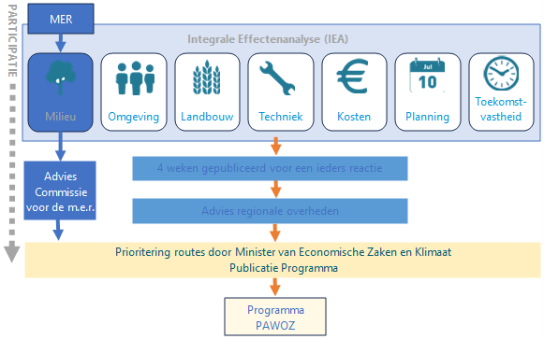
It also identifies measures to prevent or minimise adverse environmental impacts. The investigation covers more than the environment alone. For example, the Integrated Impact Analysis (Integrale Effect Analyse, IEA) also covers other areas such as engagement and stakeholder management and costs (see figure).
Feasible and in line with permit regulations
In the PAWOZ, routes have been identified where there is sufficient physical space and environmental scope for laying cables and pipes. Sufficient physical space means that the routes are feasible in light of the technical requirements and the constraints relating to the cables and pipelines. Sufficient environmental scope means that permits can be awarded for the routes based on environmental impact assessments, taking into account potential mitigation measures, cumulative effects and statutory limit values.
Under the Environment and Planning Act, a planMER is required for a project of this magnitude. This is an environmental statement that systematically, transparently and objectively identifies the project’s environmental impacts.
It also identifies measures to prevent or minimise adverse environmental impacts. The investigation covers more than the environment alone. For example, the Integrated Impact Analysis (Integrale Effect Analyse, IEA) also covers other areas such as engagement and stakeholder management and costs (see figure).
Major challenges
Several routes through the Wadden Sea were examined, including one route intended solely for cable systems, two routes intended solely for pipelines, and two routes intended for both cable systems and pipelines. A tunnel system beneath the seabed with an entry point in the North Sea was also examined.
The impact analyses for the Wadden Sea routes show that each route is associated with significant challenges in respect of minimising environmental impacts. There are more possible routes for pipelines than for cable systems, because cable systems must come ashore in Eemshaven, whereas pipelines can also make landfall at other connection nodes in the Waterstofnetwerk Nederland.
Energy Transition Tunnel
One of the greatest challenges is to lay the cables and pipes through the Wadden area in the most responsible manner possible. The Wadden Sea is a unique and protected nature reserve, which is also used for other purposes, such as recreation, fishing and shipping.
Other key considerations include the landscape, features of cultural, historical and archaeological value in the north of the Netherlands, as well as the agricultural plots that are important for seed potato cultivation.
One notable alternative in this programme is an energy transition tunnel. As the cables and pipelines pass through a Natura 2000 area, an alternative has been worked out that involves routing the cables and/or pipelines through tunnels bored beneath the seabed.
Tunnels: practical research
These tunnels are approximately 27 kilometres long, have an entry point on an artificial island in the North Sea, pass under the Wadden Sea, and then emerge near Eemshaven. An innovative idea that has never before been implemented in this form anywhere in the world.
To assess the feasibility of an energy transition tunnel, we researched a number of key aspects relating to:
- heat generation and cooling concepts for this solution;
- consequences of possible short circuits, electromagnetic interference (EMC) and earthing;
- methods for safely and efficiently installing long cables or pipelines in a tunnel;
- techniques for boring a 27-kilometre tunnel to an artificial island, without an intermediate station;
- low-maintenance design for general safety and safe maintenance.
This investigation – along with a number of supporting studies – lays the groundwork for a programme in which the Ministry will decide which routes may be used for cables and pipelines. The planMER was submitted in early 2025.
Link to the report: MER-hoofdrapport - Programma Aansluiting Wind Op Zee (PAWOZ) - Eemshaven - (Ontwerp)programma
More information
